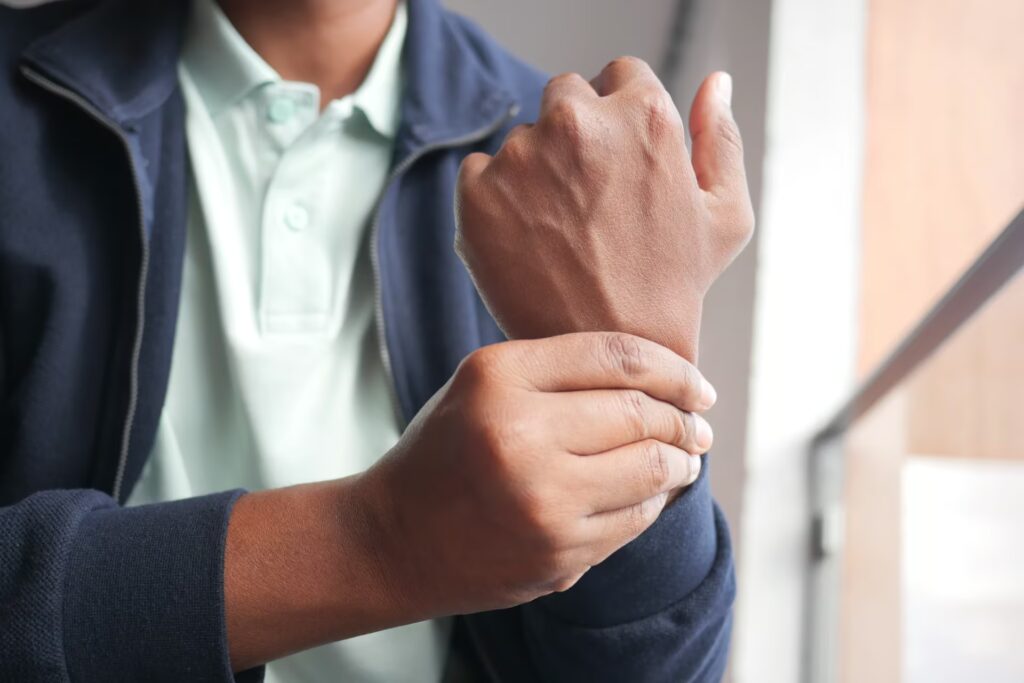
Carpal Tunnel Syndrome
Carpal tunnel syndrome occurs when the Median Nerve (which supplies sensation to your thumb, index and middle finger and some of the muscles including the big one at the base of your thumb) gets compressed where it travels through a tunnel in the wrist that is formed of an arch of wrist bones connected by a structure called the Flexor Retinaculum (FR) or Transverse Carpal Ligament.
If the area becomes swollen it can compress the nerve as it passes through. This can be caused by repetitive strain, wear and tear, inflammatory or autoimmune conditions and fluid retention, it is also common in pregnancy.
The most common symptom is tingling or numbness in the fingers described above, although as it progresses it can also cause weakness in the hand and, if very severe, wasting of the muscles.
Carpal Tunnel Syndrome usually responds well to manual therapy, particularly if its caused by degenerative changes or repetitive strain. If the condition doesn’t respond it may be necessary to have a corticosteroid injection or in some cases surgery.
Other Conditions of the Wrist and Hand
There are many other of conditions effecting the hand. The important thing is differential diagnosis, particularly where nerve compression is concerned. Is the nerve compromised centrally (ie the spine)? Or the periphery (shoulder/elbow/wrist)?
Fortunately, there are a number of standard tests which, coupled with our experience, help us to determine the cause of the problem.
Guyons Tunnel Syndrome
Guyons Tunnel Syndrome is very similar to Carpal Tunnel Syndrome, except that it is affecting a different nerve in a different tunnel. Guyons Tunnel is on the little-finger side of the heel of your hand, where the ulnar nerve can become compressed leading to tingling or numbness in the little and ring fingers, and weakness in these fingers. This is sometimes known as handlebar palsy because of the prevalence of this condition amongst regular cyclist that compress this tunnel where they rest there wrist on the handle bar. Treatment is similar to that of Carpal Tunnel Syndrome.
De Quervains Tenosynovitis
De Quervains Tenosynovitis is a disorder of the tendon at the back of your thumb. It causes pain at the base of the thumb and wrist where the tendon becomes inflamed. This can be due to repetitive strain, but is also more common in pregnancy or with sufferers of diabetes and rheumatoid arthritis. Pain may occur when you twist your wrist picking something up between finger and thumb. Because of the swelling on the tendon people can hear a squeak, crackle or snap when they move the wrist or thumb.
Dupuytren’s Contracture
Dupuytren’s Contracture is a progressive thickening of the tendons on the palms of the hands, mainly affecting the middle, ring and little finger tendons.
The first symptom is usually a thickness or a nodule in the palm, this can be tender to touch or completely painless. The hand will become progressively less flexible and the effected fingers will start to curl, grip strength will decrease effecting the patient’s ability to hold objects.
Sometimes called “Vikings Disease” because it is more prevalent in Northern Europe and Scandanavian countries. It has been called the “curse of the MacCrimmons”, a Scottish clan famed for its pipers in the 15th to 18th centuries, many of whom were unable to play in later life because of the contractures of their fingers.
Many patients suffering with Dupuytren’s Contracture require surgery to loosen the tissues in the palm. There are other treatments available including radiation therapy and an injection to break down the scar tissue.
Physical therapy has little effect once the condition has become established. Although we have found with our patients that treatment and exercises can slow the progression.